Which 3D printing material should you choose?
What the material decides
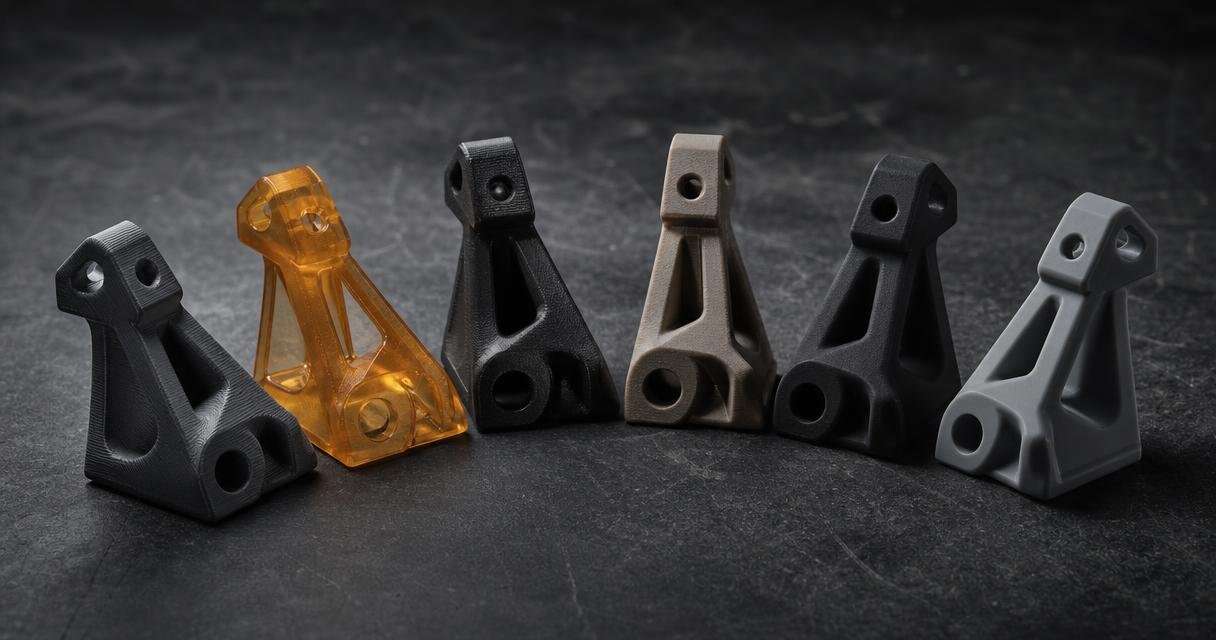
Picking a material is not a detail you settle at the end — it decides whether your part survives its job. The same model printed in three materials gives you three different objects: one that looks superb on a shelf, one that takes a beating outdoors, and one that bends in a hot car. Geometry is only half the answer.
This guide covers the six materials we print in, what each is genuinely good at, and the jobs each one will quietly fail at. If you already know what you need, skip to the quick comparison.
Quick comparison
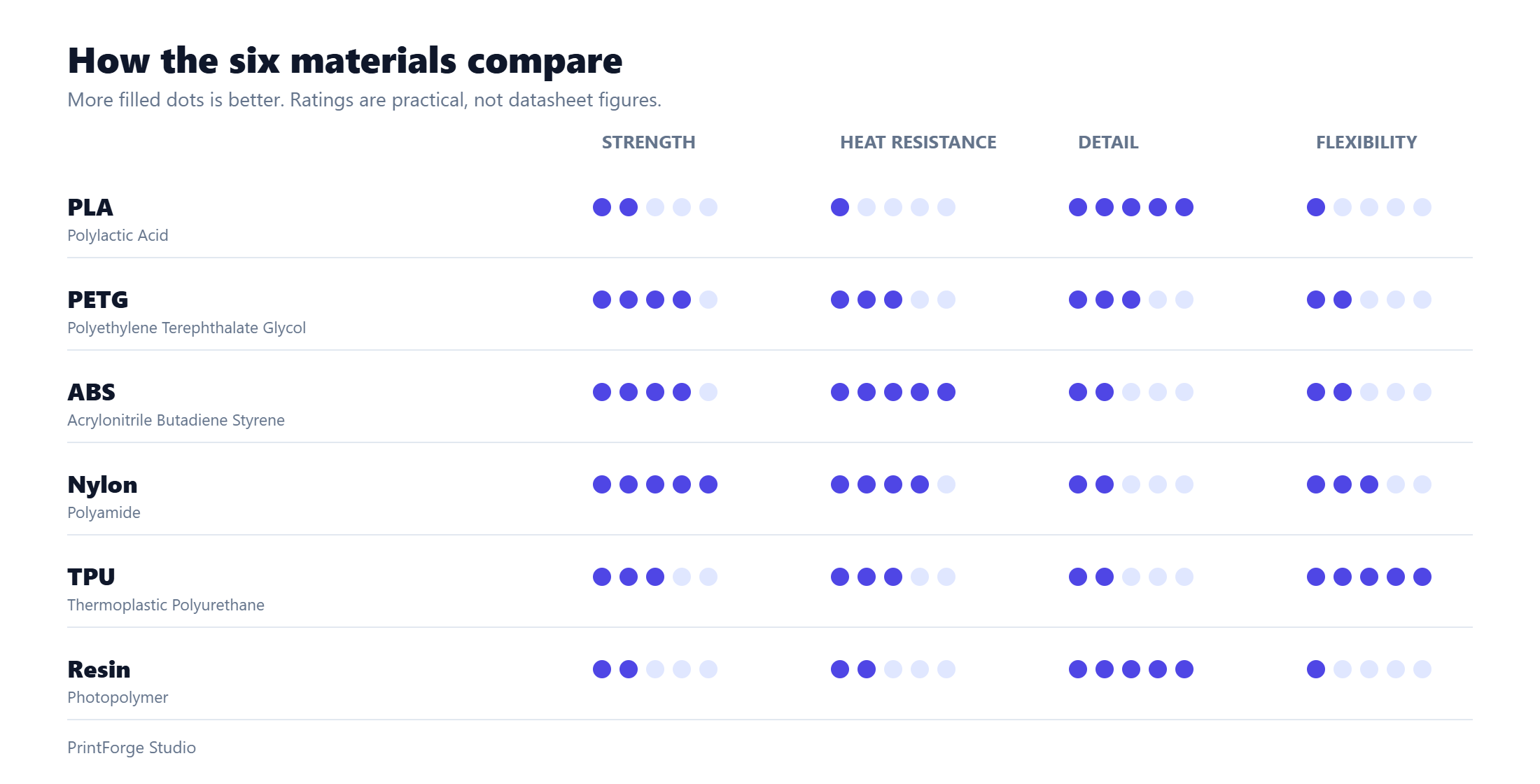
The chart is the at-a-glance version; the table adds what each one is known for.
| Material | Strength | Heat resistance | Detail | Best known for |
|---|---|---|---|---|
| PLA | Stiff, brittle | Low (~60°C) | Very good | Looks, speed, cost |
| PETG | Tough, slight flex | Medium (~80°C) | Good | Everyday functional parts |
| ABS | Tough, machinable | High (~100°C) | Moderate | Heat and post-processing |
| Nylon | Very tough, wear-resistant | High | Moderate | Gears and moving parts |
| TPU | Flexible, near-unbreakable | Medium | Moderate | Anything that must bend |
| Resin | Hard, brittle | Low–medium | Exceptional | Fine detail and smooth skin |
PLA — Polylactic Acid

PLA is the default for good reason. It prints cleanly at low temperatures, barely warps, holds crisp edges, and comes in the widest colour range. If a part is going to sit on a desk, a shelf or a shop counter, PLA will usually look the best of anything here.
Choose PLA for
- Display models, architectural models and scale props
- Prototypes where you are checking fit and form, not strength
- Toys, ornaments, gifts and indoor décor
- Large cosmetic parts, because it does not warp
Avoid PLA for
- Anything left in a car or in direct sun. It softens around 60°C and a dashboard beats that easily
- Load-bearing brackets — it is stiff but snaps rather than bends
- Outdoor parts over a long period
- Threads and clips that flex repeatedly
In one line: the best-looking, cheapest, easiest option — as long as it stays indoors and is not asked to take a load.
PETG — Polyethylene Terephthalate Glycol

PETG is the sensible middle ground and our usual recommendation for parts that have a job. It keeps most of PLA's ease while being considerably tougher: it bends before it breaks, shrugs off moisture and UV, and holds up near 80°C. Layer bonding is excellent, which matters more for real strength than the headline tensile number.
Choose PETG for
- Brackets, mounts, enclosures and protective covers
- Outdoor fittings and anything exposed to damp
- Parts that will be dropped, flexed or knocked
- Containers and organisers
Avoid PETG for
- Very fine miniature detail — it strings more than PLA and softens sharp features
- Parts needing a mirror finish straight off the printer
- Sustained high heat, where ABS or Nylon is the better call
In one line: if the part has to work rather than just look right, start with PETG.
ABS — Acrylonitrile Butadiene Styrene

ABS is the heat-and-workshop material. It holds its shape close to 100°C, takes drilling and tapping without cracking, and can be vapour-smoothed to a glossy, almost injection-moulded finish. The trade-off is discipline: it needs an enclosure and good ventilation, and it will warp or split if it cools unevenly.
Choose ABS for
- Parts that live near heat — engine bays, light fittings, electronics housings
- Anything you intend to drill, tap, sand or glue afterwards
- Jigs and tooling that take repeated handling
- Parts you want vapour-smoothed to a glossy finish
Avoid ABS for
- Large flat parts, which are the most likely to lift at the corners
- Fine decorative detail — PLA or resin will look better
- Food contact
In one line: choose ABS when the part must survive heat or go under a drill.
Nylon — Polyamide

Nylon is the engineering choice for things that move. It is extremely tough, resists abrasion better than anything else on this list, and has naturally low friction, so gear teeth and sliding surfaces wear slowly instead of grinding away. It also absorbs moisture from the air greedily, which is why we dry it before every print — damp Nylon prints badly and loses much of its strength.
Choose Nylon for
- Gears, pulleys, bushings and bearing surfaces
- Living hinges and snap fits that flex thousands of times
- Functional mechanical parts under real load
- Parts that rub against something else in service
Avoid Nylon for
- Tight dimensional tolerances — it shrinks more than PLA or PETG
- Cosmetic parts; the surface is matte and slightly furry
- Humid storage without a sealed box
In one line: the material for parts that spend their life in motion.
TPU — Thermoplastic Polyurethane

TPU is rubber you can print. It bends, squashes and springs back, and it is close to impossible to snap. We print it slowly — a flexible filament pushed too fast simply buckles — so expect a longer print time than a rigid part of the same size.
Choose TPU for
- Phone cases, bumpers and protective sleeves
- Gaskets, seals and vibration dampers
- Wheels, tyres, grips and feet
- Wearables and anything that sits against the body
Avoid TPU for
- Anything that must hold a rigid shape
- Fine sharp detail
- Tall thin models, which wobble as they print
In one line: if the part has to bend and come back, it is TPU.
Resin — Photopolymer
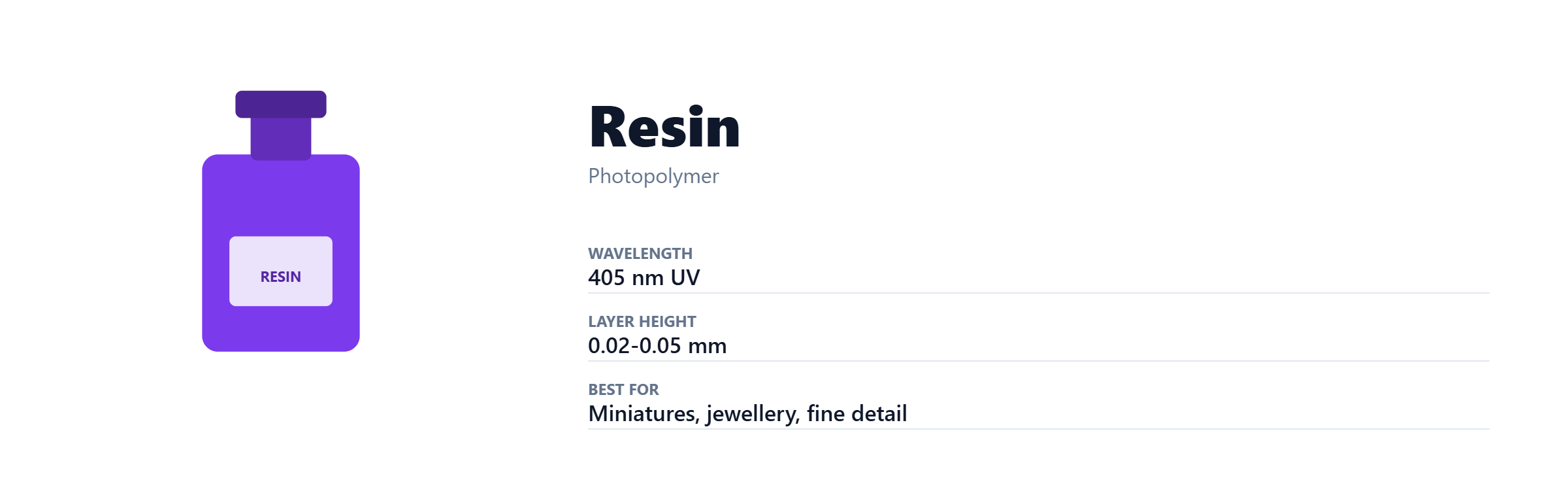
Resin is a different process entirely: liquid cured by light, layer by layer, at a resolution filament cannot approach. Faces, fabric folds, filigree and text come out sharp, and the surface is smooth enough to paint straight away. Standard resin is hard but brittle, so treat parts as detailed rather than durable, and keep them out of direct sunlight.
Choose Resin for
- Miniatures, busts and tabletop figures
- Jewellery masters and casting patterns
- Dental, medical and anatomical models
- Any display piece where visible layer lines would spoil it
Avoid Resin for
- Large structural parts — it is brittle and the cost climbs quickly with volume
- Parts that will be dropped or flexed
- Outdoor use; UV keeps curing it until it becomes fragile
In one line: unbeatable detail, as long as the part's job is to be looked at.
Still deciding? Answer one question
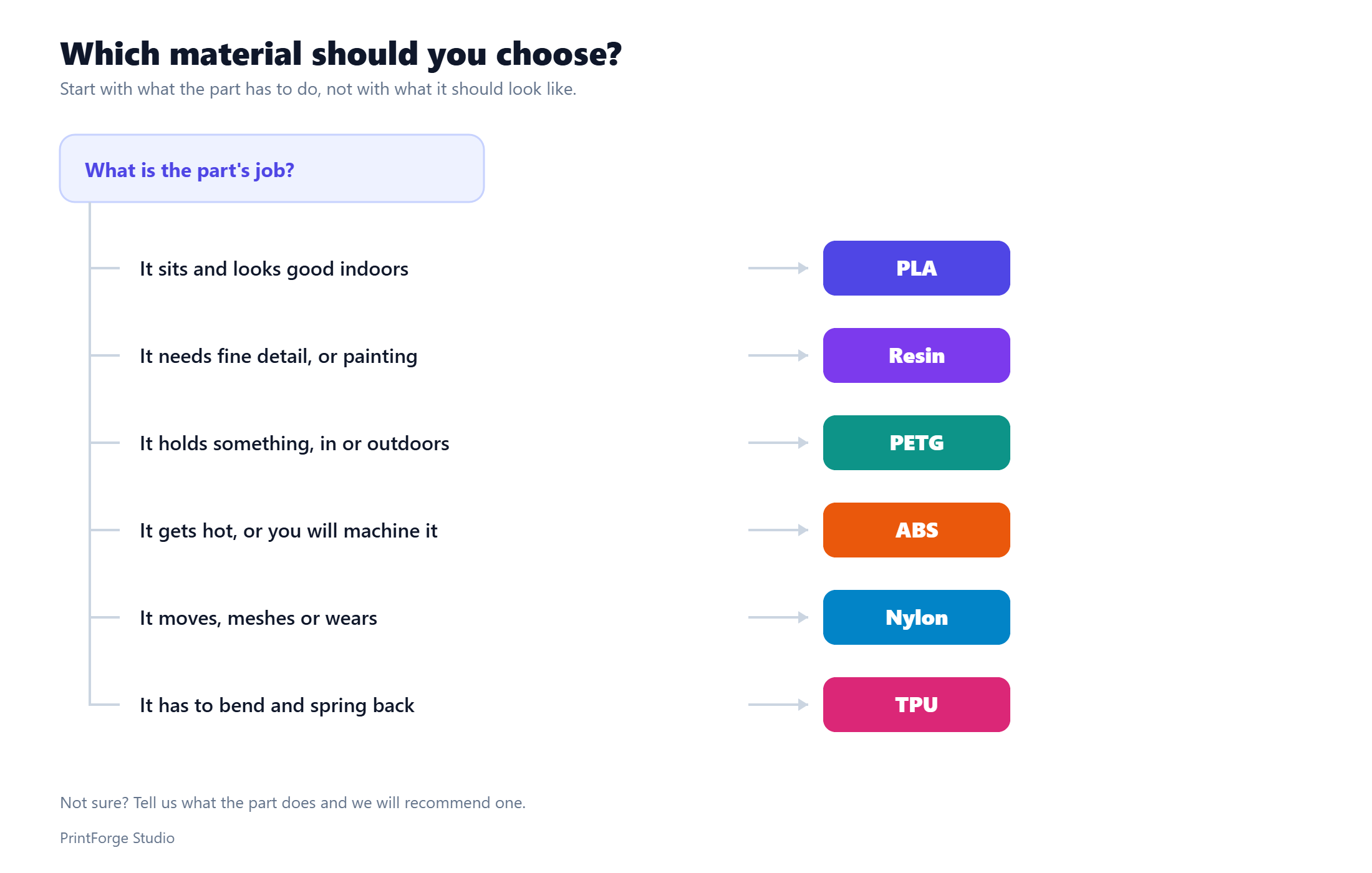
What is the part's actual job?
- It sits and looks good indoors → PLA
- It needs very fine detail or will be painted → Resin
- It holds something, outdoors or in → PETG
- It gets hot, or you will machine it → ABS
- It moves, meshes or wears → Nylon
- It has to bend and spring back → TPU
Still not sure? Tell us what the part does and we will recommend one — it costs nothing to ask, and it is much cheaper than reprinting.
A few things worth knowing before you order
- Orientation matters more than material. Layer lines are the weak axis in every filament here. A part loaded along its layers is far weaker than the same part printed upright
- Infill is not strength. Going from 20% to 50% adds weight and cost for modest gain; adding perimeters usually helps more
- Thin walls fail first. Anything under about 1.2 mm is fragile regardless of material
- Colour can change the finish. Dark colours hide layer lines; translucent ones show every one of them
Upload your model for an instant quote, or browse ready-to-print designs if you would rather start from something proven.